
Rhinoplasty
Semi-Fantasy Rounded-Tip Nose: What It Actually Means and Which Faces It Suits

Quick answer
"Semi-fantasy rounded-tip nose" is an everyday term, not a medical category. It usually means a soft, rounded tip rotated slightly more upward than a classic natural nose, with a gentle break above the tip and a straight or softly curved bridge. It has no exact boundary, so it should be described to the surgeon through four measurable features: tip rotation, tip projection, supratip break and the line of the bridge.
- What the name is
- Everyday term, no medical boundary
- Four measurable features
- Tip rotation, tip projection, supratip break, bridge line
- What decides feasibility
- Skin thickness, cartilage strength and nose length, more than face shape
Go to the consultation with three specific photos (front, profile, three-quarter), not just a name.
Key points
- Semi-fantasy rounded-tip nose is an everyday term and has no medical classification.
- To describe it to a surgeon, specify tip rotation, tip projection, supratip break and the line of the bridge.
- Whether the shape is achievable depends more on skin thickness, cartilage strength and nose length than on face shape.
What does "semi-fantasy rounded-tip nose" actually mean?
"Semi-fantasy" is an everyday term among patients and social-media pages, not a medical classification. It usually describes a nose that looks natural from the front and in profile, but whose tip is rotated slightly more upward than a classic nose, is soft and round, and has a gentle break just above it. Because there is no exact boundary between "natural", "semi-fantasy" and "fantasy", two people who use the same name can easily picture two completely different noses.
This article is educational and does not give a diagnosis or an individual plan. Its aim is to show four measurable features behind the name, explain what the evidence says about preferred angles, and make clear what kind of criteria to ask about when you wonder "which face does it suit". If you are looking for prices, see the article on the cost of semi-fantasy, fantasy and doll rhinoplasty; cost is not discussed here.
Four measurable things behind the name
When you ask a surgeon for a "semi-fantasy nose", they have to translate the name into a few specific features. These four are what you should talk about in the consultation.
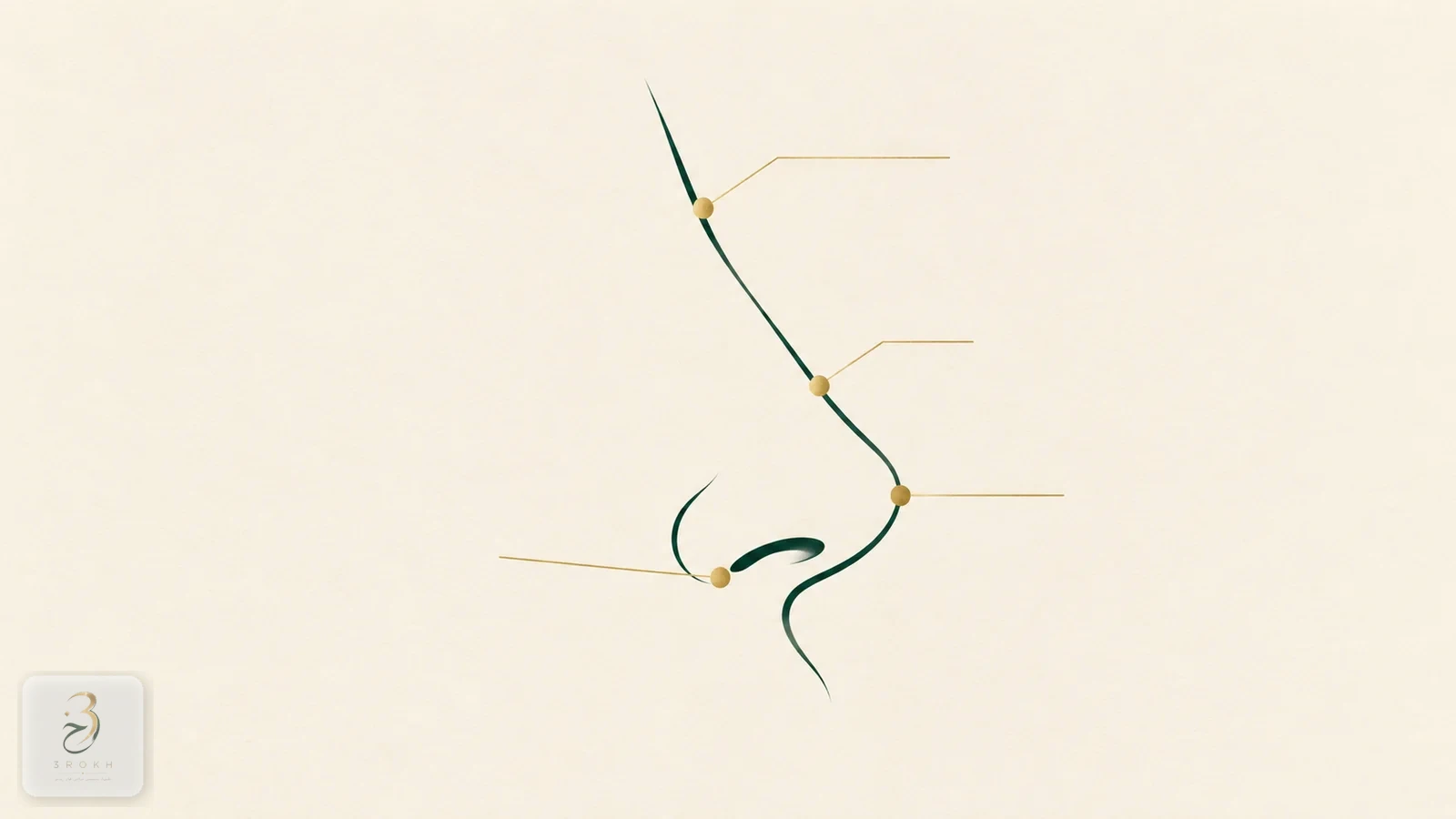
- Tip rotation: how far the tip is turned upward. Surgeons usually measure it with the angle between the nose and the upper lip (the nasolabial angle) or the angle of the columella to the face. More rotation means a higher tip and more of the nostrils visible in profile. The angle is covered in detail in the article on the nasolabial angle.
- Tip projection: how far the tip stands out from the face. Projection and rotation depend on each other; changing one changes the other. The vocabulary is mapped in the article on nasal projection.
- Supratip break: the point in profile where the line of the bridge dips slightly toward the tip and then rises again. A gentle break makes the tip look more defined and "designed"; a sharp break, or none, gives a different feel.
- Line of the bridge: straight, slightly curved, or slightly scooped (the "ski-slope" in surgical slang). Whether the bridge stays straight or becomes gently concave creates a large part of the "fantasy" impression, and it is decided almost independently of the tip itself.
| Feature | Classic natural nose | What "semi-fantasy" usually means | Main limiting factor |
|---|---|---|---|
| Tip rotation | Balanced | Slightly more upward | Nose length and tip support |
| Tip projection | Proportionate to the face | Close to natural or slightly more | Cartilage and skin |
| Supratip break | Faint or gentle | Gentle but visible | Skin thickness above the tip |
| Bridge line | Straight | Straight or softly curved | Height of the root and its relation to the tip |
This table is a general description, not a standard; the middle column is read a little differently by every surgeon and every patient, which is why showing a photo works better than using a name.
What does "rounded" really mean?
"Rounded tip" carries three different meanings that need to be separated. The first is a refined, soft tip with a gentle curve and no sharp angle; this is usually what people ask for in a "semi-fantasy rounded tip". The second is a broad, undefined tip that looks large and bulb-like; this is not the desired result, and is sometimes exactly what the patient wants to move away from. The third is a pointed, pinched tip, which can look artificial even with little rotation.
Three things decide which of these is achievable. First, skin thickness: in a study that graded 166 patients by skin thickness, the authors wrote that patients with thick skin should be warned about swelling and lack of definition. Second, cartilage strength and size: weak or small cartilages cannot hold the tip in a new shape. Third, previous surgery: skin and soft tissue are thicker and stiffer after a first operation; in an ultrasound study the soft-tissue envelope was thicker after revision surgery than after primary surgery in most regions, and swelling settled slightly more slowly. For thick skin in detail, see the article on the fleshy nose and realistic results.
What do the angle numbers say?
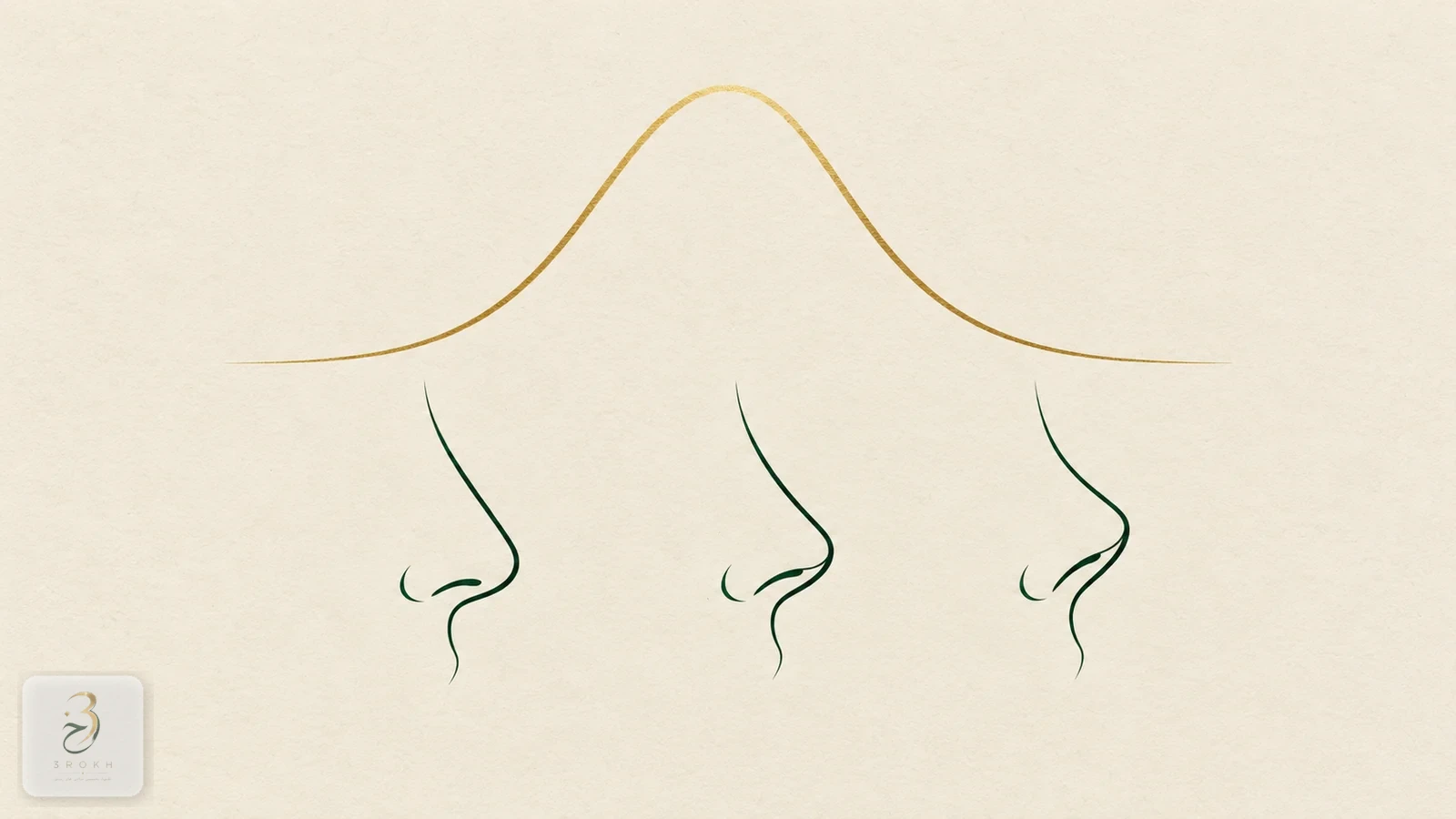
Because "fantasy" is in practice measured by tip rotation, it is natural to ask what the preferred angle is. The research answer is that there is no fixed number, and it depends on population and method:
- In a digital study with about 4,000 participants and profile images of young white women, a columellar-facial angle of about 106 degrees was the most preferred.
- In a Chinese study with 703 respondents (including 50 plastic surgeons), a nasolabial angle of 106 degrees was the first choice in every group.
- In a Saudi study with 1,027 raters, the mean preference for both sexes was about 90 degrees, a much less rotated tip than Western averages; the author concluded that what counts as under-rotation in another culture may simply be the ideal in this region.
- In a cross-sectional study of Canadian, Saudi, Kuwaiti and Lebanese participants, the mean preferred angle was about 109 degrees for a female face and about 97 degrees for a male face.
- In a study from Tehran that showed manipulated pictures of one female and one male model to 203 patients attending a facial plastic surgery clinic, the preferred nasolabial angle (judging by the range of images used for each model) was about 107.6 degrees for the female model and about 98.9 degrees for the male model; the authors concluded these angles agree with Western neoclassical canons, although participants preferred a wider angle between forehead and nose.
All of these are opinion surveys on manipulated images, not results of real surgery or long-term patient satisfaction, and only one of them (the Tehran study) is Iranian, and that used just one female and one male model. They should not be used to build a personal number. What can be taken from them is that the idea of a "best angle" is local and depends on culture and age, and that the term "semi-fantasy" also has its own boundary in every population.
Another finding deserves attention. In a study of 813 lay respondents rating simulated images of four patients, rotating the tip alone produced no significant change in attractiveness, apparent age or approachability; but reducing the hump of the bridge, and combining it with tip rotation, increased perceived attractiveness and health. The conclusion is not that tip rotation is irrelevant; it is that its effect cannot be judged apart from the rest of the nose, and the final look depends on how tip, bridge and base work together.
What keeps the rotation in place?
Tip rotation is the raising of the tip cartilages, and those cartilages have to stay in that position. There are several ways to build and hold rotation: shaping sutures, shortening part of the lateral cartilages and supporting grafts. All of them lose some of their effect over time.
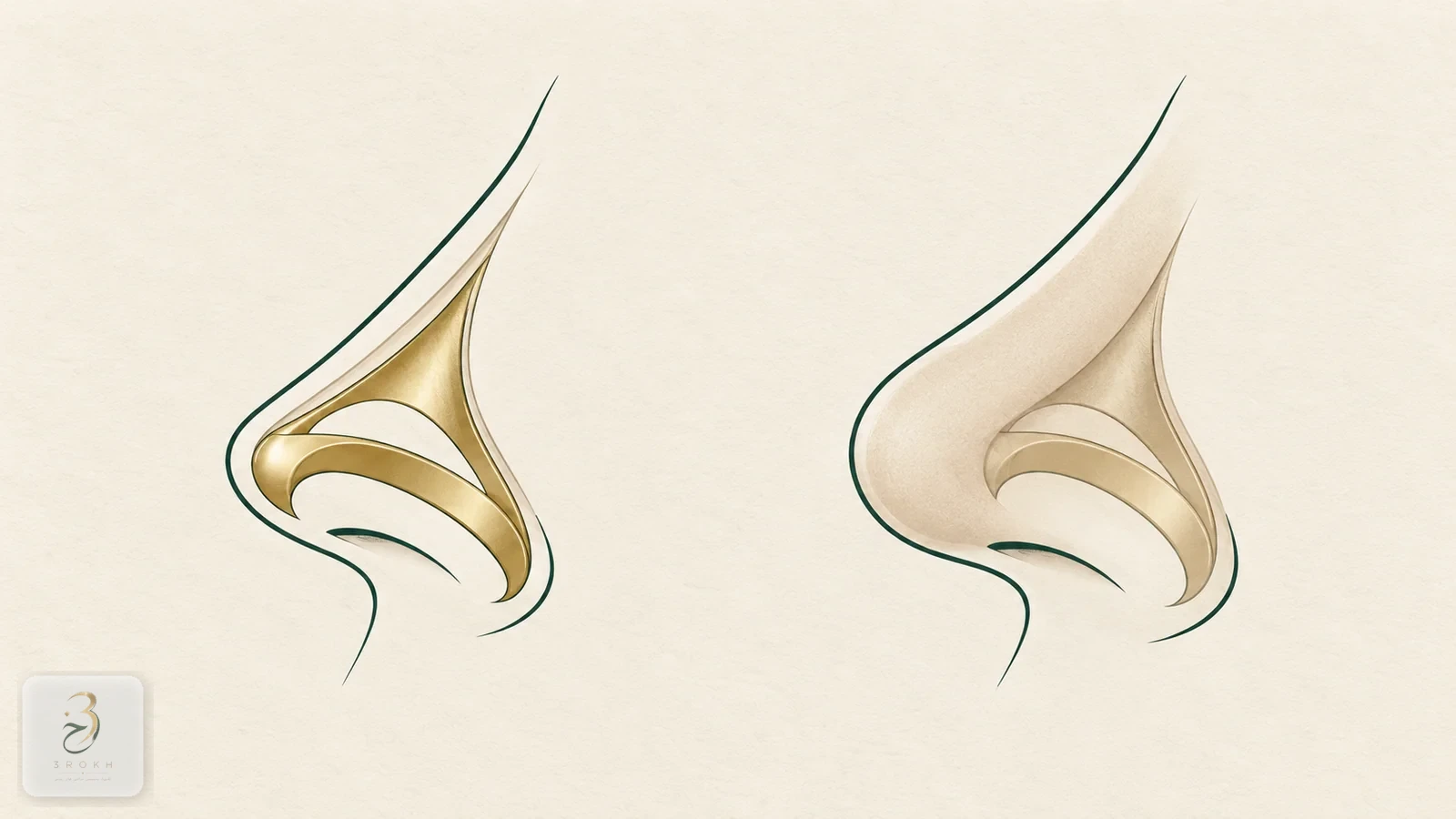
In a retrospective review of primary rhinoplasty patients with at least one year of follow-up, average rotation loss was about 4.9 degrees with a columellar strut graft and about 1.3 degrees with a septal extension graft; projection loss was 4.7% and 0.2%, respectively. In a prospective randomized trial of 60 patients, both methods lost most in the first month, and the septal extension graft kept stability better but was less flexible than the strut. A systematic review of 571 patients came to a similar summary: septal extension grafts give more long-term stability, yet some surgeons prefer the other method for particular patients. None of this is a guarantee, and every case depends on the cartilage available and the structure of the septum.
A practical point for the patient: the look of the tip in the first weeks cannot be relied on because of swelling and early tissue change, and part of the loss happens in those first months. To see how swelling evolves over time, read the week-by-week rhinoplasty recovery guide.
The short nose and over-rotation: the other side of the story
A shape requested as "semi-fantasy", if pushed past its limit, ends in what surgical texts call the "short nose". A specialist review of this problem lists three shared features: a shortened nasal length, over-rotation of the tip and increased nostril show. They occur together, and patients usually describe it as "the tip is too high" or "the nostrils show too much".
Correcting it is usually harder than the first operation, because the lost length generally has to be rebuilt with cartilage and the envelope is thicker and more prone to swelling in revision surgery. If you recognise this in your own nose or in a previous result, read the article on what revision rhinoplasty fixes and the article on timing of a second surgery. This is one reason to prefer a cautious shape: a little more rotation can be adjusted later, but bringing back an over-rotated tip is the harder job.
Where does semi-fantasy sit on the spectrum?
To make the position of this name clearer, the table below puts four common names side by side by direction of change. It is not an official boundary; it only says in which direction each name usually moves away from a natural nose, which is why the risk of over-rotation and the need for structural support grow along the spectrum.
| Everyday name | Tip | Bridge | Nostrils seen in profile | Need for structural support |
|---|---|---|---|---|
| Natural | Proportionate to the face | Straight | Little seen | Usually less |
| Semi-fantasy | Slightly rotated, round and soft | Straight or softly curved | Slightly more visible | Moderate |
| Fantasy | Clearly rotated | Sometimes slightly scooped | More obvious | More |
| Doll | Short and rotated | Short and narrow | Clearly visible | Greatest |
The difference between the last two names is examined separately in the article on doll versus Barbie nose. In every row, your face shape and sex influence the surgeon's choices, but the ceiling of what is achievable is set by the structure of the nose itself.
How is rotation built in the operation?
The patient does not need the technical details, but knowing the general logic helps explain why some requests are simpler than others. The tip of the nose is formed by two pairs of semi-flexible cartilages (the lateral cartilages) that rest on the septum and the base of the columella. To raise the tip, the surgeon usually combines some of these steps:
- Shaping sutures: the cartilages are brought together or fixed in a new position without removing much. In tips with suitable cartilage and a not very thick covering this may be enough on its own.
- Shortening or reducing part of the lateral cartilage: this makes the tip smaller and higher, but enough cartilage has to remain so that the nostrils and the external nasal valve do not collapse. In a retrospective study comparing two methods for changing the nasolabial angle, both worked; the columellar-septal suture gave more rotation but carried a higher risk of over-rotation, while cartilage shortening gave more predictable results.
- Supporting grafts: where the tip cartilage alone cannot hold the rotation, cartilage from the septum, ear or rib is used as a support. These are the grafts discussed in the earlier section on durability.
In all of these, the surgeon balances three things at once instead of one number: the rotation wanted, the projection wanted and the strength needed for breathing. Raising the tip without regard for the external valve may look good yet reduce airflow. That is why breathing should be discussed in the consultation even if your main concern is only appearance.
What does the tip go through after surgery?
A freshly operated tip looks large, firm and high in the first weeks, and this differs from the final result. Swelling is the main factor. In a small study measuring nasal volume in seven patients, swelling peaked at the fourth week, dropped quickly until the eighth week, and then the nasal volume changed slowly until the end of the first year. The study is small and must not be read as a fixed timetable, but it is a reminder that the tip at 12 months looks different from the tip at one month.
Two things are worth keeping in mind for the semi-fantasy shape. First, because of swelling the tip usually looks rounder and higher than the final result in the early months, and its definition appears as the swelling settles. Second, part of the rotation is lost in those early months, so judging "too high" or "under-rotated" in month one is premature. Avoid touching or pressing the tip; the reason is in the article on touching the nose after rhinoplasty.
Common misunderstandings
- "The sample photo is my result." A sample photo is the result of another nose with other skin and other cartilage. It is useful only to describe direction and feel.
- "Semi-fantasy means the tip must be clearly up." Many people who say this name really want "a refined tip a little higher than before", not obvious rotation. If that is what you want, less rotation also meets the goal and carries less risk.
- "If it falls short, a filler or a small procedure will fix it." Small corrections are possible in some tips, but they should not be imagined as a substitute for correct planning; see the options in the article on tip touch-ups after a first operation.
- "Only the tip matters." As the social-perception study showed, the bridge and the harmony of the whole shape affect the viewer more than rotation alone.
Which face does it suit?
The title of this article asks this question, and the honest answer is that no trial has shown which nose model is better on which face shape. What surgeons actually check are specific proportions, not whether a face is "round" or "long". Ask about these in the consultation.
- Current nose length relative to the midface: a longer nose has room for more rotation; a nose that starts short reaches the "short nose" look sooner with more rotation.
- Upper lip length: tip rotation changes the relationship between the nose and the upper lip. A short or long upper lip can lead a surgeon toward a different amount of rotation.
- Profile and the balance of chin and forehead: the nose is not judged alone. A recessed chin or a more prominent forehead can change how the tip is perceived, and sometimes part of the answer is not the nose itself.
- Face width and the base of the nose: from the front, the width of the nose base is judged against the distance between the eyes and the width of the face. A rounded tip with a proportionate base matters more than whether the face is round. For an example of judging by face width, see the article on nose shape for round and plump faces.
- What "natural" means to you: some people ask for semi-fantasy because they do not want the nose to look operated at first glance; that goal is better met by less rotation and a refined tip than by a lot of rotation.
The conclusion is that whether this shape is achievable depends more on the structure of the nose itself than on face shape: skin, cartilage, length and septum. A round or long face is a secondary factor.
Which noses have limits?
- Thick, oily skin: tip definition is reduced and swelling lasts for months. The shape can be made softer and better proportioned, but a sample photo of a thin-skinned nose cannot be reproduced.
- Little or weak cartilage: holding rotation requires cartilage from the septum, ear or rib. If the septum has been cut before, the source is more limited. The cost and time of this part are in the article on cartilage, grafts and implants.
- A nose that is short from the start: more rotation reaches a short-nose look sooner.
- Deviated septum or breathing problems: sometimes the cosmetic shape must be combined with fixing function; the article on septorhinoplasty explains this combination.
- Previous surgery: a revision case carries more risk and more limits.
How to talk with the surgeon
A published clinical practice guideline from the American Academy of Otolaryngology-Head and Neck Surgery on rhinoplasty advises that the surgeon ask about the patient's motivation and expectations, say whether they are realistic and document the conversation; also that the patient be told what to expect after surgery and about the possible need for future surgery, and that satisfaction be documented at least 12 months after the operation. You can use these as questions for the consultation.

- Bring three specific photos: front, profile and three-quarter view, ideally of someone with a structure close to yours, not only a celebrity face.
- State the four features in your own words: "tip slightly higher than natural", "straight bridge", "gentle supratip break" and "round but defined tip".
- Ask: by what method will my rotation be built and how much loss is expected? Where will the cartilage come from? What if the result is over-rotated or under-rotated?
- Use simulation as a shared language, not a promise; its limits are described in the article on simulating the result of rhinoplasty.
- More questions are in the article on questions to ask a surgeon.
How to read sample and before-and-after photos
Because tip rotation is something judged by eye and by camera angle, a photograph can mislead. In the scientific literature the nasolabial angle is defined against a line set by the Frankfurt horizontal plane (an imaginary line from the lower edge of the eye socket to the top of the ear canal); in other words, if the head is tilted slightly up or down in a picture, the same tip shows a different angle. In a study of members of the Rhinoplasty Society, even experienced surgeons overestimated the angle by about 2.8 degrees on average. The practical lessons:
- Do not use a sample photo in which the head is tilted or raised as your reference.
- Compare a surgeon's before-and-after photos only when angle, lighting and camera distance are the same; the article on how to read before-and-after photos covers this in more detail.
- Ask the surgeon to look at the same pictures in a standard head position, not only in photos the patient picked.
- Remember that a tip after months of swelling, and after the first year, differs from the tip at month one; a photograph taken less than three months after surgery is not the final result.
When to consult in person
- When you can describe the shape you want only with a name and have no specific photo.
- When you have thick skin, a nose that is short from the start, or previous surgery.
- When you also have a breathing problem.
- When after earlier surgery the tip is very high or the nostrils show too much.
An in-person consultation with Se Rokh's doctors is possible through booking, and the scope of the work is explained on the rhinoplasty page. In the end, if you are undecided, a cautious shape is usually safer than an extreme one, because softening is easier than reversing.

Sources
- Ahmed O et al. Population-based assessment of currently proposed ideals of nasal tip projection and rotation in young women. JAMA Facial Plast Surg. 2014
- Sun S et al. The Ideal Nasal Tip Projection and Rotation Angles in Chinese: A Preference Analysis of the General Population. J Craniofac Surg. 2022
- Alharethy S. Preferred nasolabial angle in Middle Eastern population. Eur Arch Otorhinolaryngol. 2017
- Alshawaf SM et al. Preferred Nasolabial Angle in Rhinoplasty: A Cross-Sectional Analysis. Aesthet Surg J. 2024
- Kandathil CK et al. Association of Dorsal Reduction and Tip Rotation With Social Perception. JAMA Facial Plast Surg. 2018
- Bellamy JL, Rohrich RJ. Superiority of the Septal Extension Graft over the Columellar Strut Graft in Primary Rhinoplasty: Improved Long-Term Tip Stability. Plast Reconstr Surg. 2023
- Kucukguven A et al. Nasal Tip Flexibility and Stability: Comparison of Septal Extension Grafts and Columellar Strut Grafts in a Prospective Trial. Plast Reconstr Surg. 2024
- Amador RO et al. Optimizing Nasal Tip Position: A Systematic Review of Columellar Strut and Septal Extension Grafts. Ann Plast Surg. 2025
- Korkmaz M, Korkmaz H. The comparison between alar cartilage shortening and columellar-septal suture techniques in nasal tip rotation. J Craniofac Surg. 2015
- Cone JD Jr, Hobar PC. The Short Nose. Clin Plast Surg. 2016
- Rasti M et al. Evaluation of Skin-Soft Tissue Envelope Thickness by Ultrasonography after Primary and Revision Rhinoplasty. Aesthetic Plast Surg. 2023
- Tatlidede S et al. Stereolithographic volume evaluation of healing and shaping after rhinoplasty operations. J Craniofac Surg. 2009
- Wigley C et al. Optimising rhinoplasty outcomes in patients with thick skin. JPRAS Open. 2025
- Tavakoli K et al.. Ideal Nasal Preferences: A Quantitative Investigation with 3D Imaging in the Iranian Population. Arch Plast Surg. 2023
- Armijo BS et al.. Defining the ideal nasolabial angle. Plast Reconstr Surg. 2012
- Brown M, Guyuron B. Redefining the ideal nasolabial angle: Part 2. Expert analysis. Plast Reconstr Surg. 2013
- Ishii LE et al. Clinical Practice Guideline: Improving Nasal Form and Function after Rhinoplasty. Otolaryngol Head Neck Surg. 2017
Frequently asked questions
Is a semi-fantasy nose the same as a natural nose?
Not exactly. It usually means a nose that looks natural from the front and in profile, but whose tip is rotated slightly more upward than the classic form and is rounder and softer. There is no precise line between natural and semi-fantasy, so it has to be defined with a specific photo.
What is the difference between a rounded tip and a broad tip?
A rounded, refined tip means a soft curve without a sharp angle but still with definition and proportionate width. A broad or undefined tip is larger and lacks definition, often with thick skin. The second is something surgery tries to improve, the first is the desired result.
Does tip rotation relapse after surgery?
Some rotation and projection is lost in the first months, and how much depends on the tip support method. In one retrospective review, rotation loss was about 4.9 degrees with a columellar strut and about 1.3 degrees with a septal extension graft; the surgeon should build this loss into the plan.
Can a thick-skinned (fleshy) nose become a semi-fantasy nose?
It can, but with limits. Thick skin reduces tip definition and keeps swelling longer, so the final result is softer and less defined than a sample photo. Review this frankly with the surgeon before surgery.
What is the ideal nasal tip angle in degrees?
There is no fixed number. Studies, depending on population and method, have preferred values from about 90 to about 110 degrees, and none is enough to set the number for one particular person. The surgeon decides it from your upper lip, nose length and structure.
Related services
Comments
No comments yet. Be the first to write one.
Related articles
Cost of Semi-Fantasy, Fantasy and Doll Rhinoplasty: Does the Chosen Shape Affect Price?
"Fantasy" and "doll" are everyday terms, not medical categories, and have no standard price. This article explains which factors really affect the work and cost and why a more dramatic shape is not simpler.
Read moreWhat Is the Nasolabial Angle and Why Do Surgeons Care About the Number
The nasolabial angle is the angle between the columella and the upper lip and shows how much the tip is rotated. This article explains how it is measured, what numbers studies report and why there is no single number for everyone.
Read morePre-Rhinoplasty Tests: The List, the Timing, and How Long Results Stay Valid
Which tests you actually need, how many weeks before surgery to take them, how long each result stays valid — and what an abnormal value really changes.
Read moreInstalment and Staged Payment for Nose Surgery: What Is Reasonable and What Is a Warning Sign?
We look separately at three models: staged payment, credit and cheques or notes, with a list of the paperwork you need, four refund situations and ten warning signs before the first payment.
Read moreRevision Rhinoplasty: What It Can Fix, What It Cannot, and When You Actually Need It
Not every disappointment after a nose job needs a second operation. A map of the real post-rhinoplasty problems and their causes, the non-surgical options, and the situations where revision surgery is the wrong answer.
Read moreWhy Does Revision Rhinoplasty Cost More Than the First Surgery?
Revision rhinoplasty typically costs more than a primary nose job. This guide explains the real reasons — from scar tissue to cartilage grafting — and how to manage the cost wisely.
Read more