

رینوپلاستی
Revision Rhinoplasty: What It Can Fix, What It Cannot, and When You Actually Need It

Quick answer
Revision rhinoplasty is any operation on a nose that has already been operated on, and it ranges from a limited tip refinement to a full structural rebuild. Reported revision rates run from 10.8% in one open-rhinoplasty series to 17% to 25% in functional septo(rhino)plasty. Contrary to common assumption, the most common complaint among revision patients is airway obstruction, at 65%. Supratip scarring and oedema are usually managed without surgery, and limited surface irregularities are sometimes corrected with filler, but most other aesthetic complications will not resolve without an operation.
- Revision rate, open rhinoplasty series
- 10.8%
- Revision rate, functional septo(rhino)plasty
- 17% to 25%
- Most common revision-patient complaint
- Airway occlusion, 65%
- Usual delay before corrective surgery
- 6 to 12 months
- Service page
- /services/revision-rhinoplasty
These figures come from different study populations and do not describe your personal probability; the decision is made only after an in-person examination.
Key points
- Revision rhinoplasty is any operation on a nose that has already been operated on, and it can range from a limited correction to a full structural rebuild.
- In a review of one hundred consecutive secondary rhinoplasty patients, the most common preoperative complaint was airway occlusion, at sixty-five percent.
- The same study found that surgeons identify significantly more deformities on examination than patients report themselves.
- Supratip scarring and oedema can usually be managed with triamcinolone injections and taping rather than requiring operative revision.
- Patients with a patent airway who still feel obstructed may have empty nose syndrome, for whom further airway-widening surgery is not appropriate.
What is revision rhinoplasty, and how does it differ from a first operation?
Revision rhinoplasty — also called secondary rhinoplasty or simply a revision — is any operation performed on a nose that has already been operated on, whether to change its shape or to open the airway. What is rarely explained is that revision rhinoplasty is not one procedure. According to the StatPearls clinical review of rhinoplasty, a second or third operation may be more aggressive than the first, or it may be minimally invasive and aimed at correcting one or two small deficiencies. The same name covers everything from a limited tip refinement to a full structural rebuild.
This article is educational and does not replace an examination. It answers the question that comes before cost and before timing: which category does my problem fall into, and does that category actually respond to a second operation? If you are researching price, why revision rhinoplasty costs more than a first operation covers that separately, and if you want to know how long to wait, revision rhinoplasty: when is it too early and when is it the right time is dedicated to timing.

The fundamental difference from a first operation lies in the tissue, not in the name of the procedure. StatPearls states that planning revision surgery must account for four realities: meticulous dissection through a previously operated and scarred field, the potential lack of available cartilage for grafting and structural support, injury to the vascularity of the nose and its effect on healing in the septum and the skin-soft tissue envelope, and the psychological impact of the earlier experience on the patient's expectations. The same source describes revision rhinoplasty as what is widely regarded as the most complicated of facial plastic surgical procedures, and notes that the healing process varies for the same patient between surgeries when a revision is performed.
What share of nose operations end in a second surgery?
There is no single number, and any figure quoted without naming the study population is misleading. Three figures from three different populations appear in credible sources, and the spread between them is itself informative.
| Source and population | Reported rate | What it means |
|---|---|---|
| StatPearls, rates typically reported in aesthetic rhinoplasty | Up to about 15% revision, up to about 3% complications | A clinical review's general estimate, not a meta-analysis |
| Series of 252 revision patients after open rhinoplasty, single centre | 10.8% | Open technique only, retrospective chart review |
| Functional septo(rhino)plasty, French review | 17% to 25% for persistent symptoms | A functional (breathing) population, not a purely aesthetic one |
The 10.8% figure comes from a review of 252 revision cases after open rhinoplasty. The same study reported the three most common aesthetic reasons for revision as insufficient nasal tip rotation (37.7%), hanging columella (30.2%) and supratip deformity (28.6%). On the functional side, a study assessing the results of revision septo(rhino)plasty states that functional septo(rhino)plasty incurs a 17% to 25% rate of revision for persistent symptoms — that is, when breathing is the primary goal, the reported likelihood of needing a second intervention is higher than in purely cosmetic surgery.
Why does the spread matter? Because "revision rate" counts something slightly different in each study: some count only second operations actually performed, some count patient requests, and some count any small in-theatre adjustment. None of these numbers describes your personal probability. What they do show is that needing a second correction is not a rare anomaly — it is part of the accepted reality of this operation, and a surgeon who presents it as impossible is not being straight with you.
The most common reason people seek revision is not what you would guess
Most people assume revision patients come back because of appearance. The data say otherwise. In a review of 100 consecutive secondary rhinoplasty patients, the most common preoperative complaint was airway occlusion, at 65% — ahead of dorsum asymmetry (33%), nostril asymmetry (18%) and tip asymmetry (14%). The authors described this finding as alarming, precisely because it suggests the airway received too little attention during the primary operation.

The study's second finding matters even more for your own decision: what the patient sees and what the surgeon sees are not the same thing. On examination, the senior author identified significantly more deformities than the patients themselves reported.
| Feature | Reported by the patient | Seen by the surgeon on exam |
|---|---|---|
| Dorsal asymmetry | 33% | 65% |
| Wide dorsum | 13% | 47% |
| Nostril asymmetry | 18% | 41% |
| Wide alar base | 6% | 38% |
| Dorsal hump | 9% | 30% |
| Columellar protrusion | 6% | 25% |
The practical meaning for anyone near a decision: the list of problems you carry in your head is probably incomplete, and an operation that corrects only the single thing bothering you may not improve the overall result. That is why a complete structural examination, rather than a conversation about one feature, is the right basis for the decision. The most common surgical manoeuvres in that same series fit this picture: septoplasty in 71% of cases, alar rim graft in 67%, dorsal graft in 63% and osteotomy in 60% — meaning most revision surgery is structural and functional work, not purely cosmetic refinement.
A map of post-rhinoplasty appearance problems and their causes
Part of what makes patients feel lost is having no name for what they see. The table below summarises recognised post-rhinoplasty deformities and their structural causes, based on StatPearls. This map exists to help you follow the conversation at your consultation, not to self-diagnose.
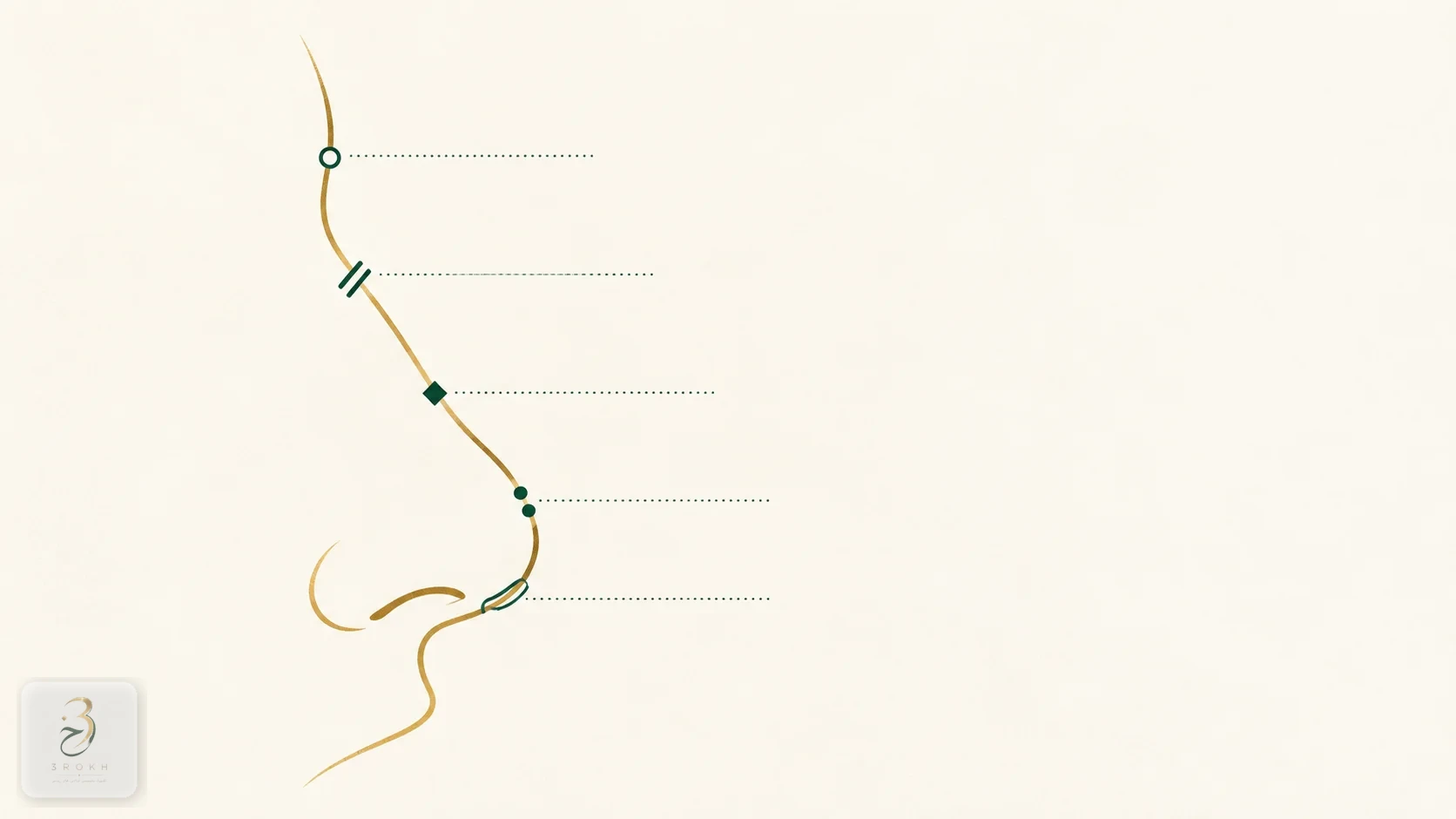
| The name you may hear | What is visible | Structural cause |
|---|---|---|
| Polly beak deformity | The area just above the tip looks rounded and over-projected, like a parrot's bill | Inadequate reduction of the cartilaginous part of a hump relative to the bony part, or over-resection of the bony part; tip ptosis and supratip scarring make it worse |
| Inverted V deformity | The lower edges of the nasal bones become sharply visible as a line | Upper lateral cartilages separated from the dorsal septum without reconstructing the midvault |
| Alar retraction | The nostril rim sits high and the nostril shows more than expected | Over-aggressive cephalic trimming when a complete strip of lateral crus at least 7 mm wide is not left intact |
| Pinched tip or tip bossae | A narrow or sharp tip, or visible point-like bumps on it | Excessive manipulation of the cartilage domes, by suturing or resection |
| Hanging columella | The central column between the nostrils sits lower than expected | One of the three most common revision reasons in the 252-case series, linked to the tip support technique used |
| Supratip fullness | Accumulated volume immediately above the tip | Broad lateral crura of the lower lateral cartilages, or scar and oedema under the skin envelope |
An important caution from StatPearls in this same section: a polly beak deformity must not be confused with a true dorsal hump, because the two are managed differently. If the diagnosis is wrong, the second operation treats a problem that is not there. If you want to follow the anatomical vocabulary more closely, the map of nasal terminology and projection explains these words with reference figures.
Which problems do not need a second operation?
This is the section commercial pages tend to skip. Two groups of post-rhinoplasty problems are usually managed without surgery.
Group one: supratip scarring and oedema. StatPearls states plainly that supratip scarring and oedema under the skin-soft tissue envelope can usually be managed successfully with triamcinolone injections and taping rather than requiring operative revision. The same source immediately draws the boundary: most other aesthetic complications will not resolve without surgery, and that surgery is generally delayed 6 to 12 months after the original rhinoplasty to let post-operative oedema subside as far as possible. The decision about injection and its dose rests entirely with your operating surgeon; this article does not prescribe treatment.

Group two: limited surface irregularities and volume deficits. A retrospective review of 2088 cases of non-surgical correction of rhinoplasty complications with hyaluronic acid filler reported the most common indications as bridge collapse or asymmetry (49.0%), an under-projected tip (44.0%) and surface irregularity or scarring (35.4%). The mean filler volume at first treatment was 0.49 mL, and the authors concluded that this approach should be considered first line before surgical revision.
That recommendation has to be read together with the same study's adverse-event figures, not apart from them: the most common adverse event at the two-week follow-up was erythema at 36.4%, and three patients (0.47%) developed skin necrosis, which in all three cases was transient and self-resolving. Skin necrosis, even at that low frequency, is a serious event — which is exactly why injecting an already-operated nose, whose blood supply has already been disturbed, is not work for an inexperienced injector.
A second study gives a more grounded sense of how often this route is used. In a review of 800 rhinoplasty patients from one surgeon's practice, 10.6% (85 patients) received filler for post-operative imperfections, with a mean volume of 0.2 mL, and in 82.3% of cases the injection was in the rhinion area, where the nasal bones meet the cartilage. In that same series, 11.8% of those patients needed a second filler session and 3.5% needed a third — so this is not a permanent solution and it has to be repeated.
Both studies are single-injector series without control groups, and one carries a declared conflict of interest. They establish this as a real option worth discussing, not as a proven superiority over surgery. The mechanism and the genuine risks of nasal filler are covered in more depth in correcting a crooked nose without surgery: what filler does.
When is revision surgery the wrong answer?
Three situations exist in which a second operation is unlikely to solve the problem and may make it worse. Recognising them before a consultation matters as much as recognising the indications.

One: the airway is open but the blocked sensation remains. StatPearls takes a clear position here. Patients who have previously undergone turbinate reduction, whose nasal passages are patent on examination but who still report obstruction, are likely suffering from empty nose syndrome and should not undergo additional surgery to widen the nasal airway; augmenting inferior turbinate volume instead may benefit them. A related condition is atrophic rhinitis, where increased airflow past a certain point leaves the mucosa dry and atrophic, producing crusting, reduced smell and the same sensation of obstruction. In both, the logic of "let us open the airway further" backfires.
Two: the structure was corrected but the symptom stayed. In the French study of 82 functional salvage surgery patients, scores improved for most patients, but 17% showed no change in their scores at all — some of them with a perfectly straight septum. The authors put exactly this in their conclusion: functional salvage surgery lets most patients recover respiratory comfort, with the exception of a few cases despite a perfectly straight nasal septum. This figure is not there to discourage you but to calibrate expectation: straightening the structure does not guarantee the symptom goes away.
Three: the real problem is somewhere else. StatPearls warns that patients with pre-existing psychiatric comorbidities such as body dysmorphic disorder, depression and anxiety are at higher risk of post-operative depression and dissatisfaction with the surgical result, and that surgery should only be offered to them after careful counselling and with strong social support. The same source notes that determining who would benefit from revision rhinoplasty is even more complex than selecting candidates for a primary operation, because these patients' expectations are shaped by their previous experience and may lead them to expect the new surgeon to fully undo what the previous one did. The psychological side of readiness is discussed further in revision rhinoplasty: when is it too early and when is it the right time.
Breathing: is the problem the nasal valve or the septum?
If breathing is your main complaint — which, on the data above, is the most common case — the answer to this question determines what a second operation should actually do. StatPearls describes two simple examinations your surgeon performs at the visit, and understanding them helps you know what is being measured.

- Modified Cottle manoeuvre for the internal valve: the patient breathes in through the nose twice, once normally and once while a small instrument supports the upper lateral cartilage without pulling it outward. Substantial subjective improvement in airflow with that support indicates that opening the internal nasal valve during surgery may be beneficial.
- Assessing the external valve: dynamic alar collapse on inspiration, particularly when it occurs on both sides, is a good indicator of external valve insufficiency. If the collapse is unilateral only, the cause is more likely asymmetric airflow from a septal deviation: the more open side carries faster flow, pressure there drops, and that relative vacuum pulls the nostril wall inward.
These two examinations explain why "I cannot breathe well" does not by itself produce a surgical plan. A second septoplasty in a patient whose problem is the external valve will not return the symptom to normal, and a supporting graft in a patient with a still-deviated septum is not enough. Note that neither of these is a home self-test — interpreting them requires clinical examination and direct visualisation inside the nose.
Not every revision is a big operation: limited versus full revision
Two patients can both have "revision rhinoplasty" and go through entirely different experiences. StatPearls treats this as the basis for planning: the second or third operation might be more aggressive than the first, or it could be minimally invasive and aimed at addressing one or two small deficiencies — and it is that pre-operative decision which determines whether the surgeon opens the nose, operates endonasally, or delivers the nasal tip.
The data from the two series cited above show that both ends of this spectrum are real. The three most common revision reasons in the 252-patient series — insufficient tip rotation, hanging columella and supratip deformity — are all localised problems in the lower third of the nose. By contrast, in the 100-patient tertiary referral series, the most common manoeuvres were septoplasty (71%), alar rim graft (67%), dorsal graft (63%) and osteotomy (60%): multi-layer reconstruction.
That difference has practical consequences for you. StatPearls notes that the endonasal and tip delivery approaches produce less severe and shorter post-operative oedema and avoid a columellar scar, while giving less surgical access in return. So your recovery length, whether you need a graft from the ear or rib, and your level of risk are not set by the label "revision rhinoplasty" — they are set by what the examination finds. The right question at a consultation is therefore not "how hard is revision surgery?" but "which end of this spectrum applies to me, and why?"
If surgery is needed, what differs from the first operation?
Three practical differences are worth knowing before you consent.
The cartilage source. StatPearls states that patients undergoing revision surgery should also consent to the harvest of tissue at extranasal sites, including conchal cartilage, costal cartilage, and temporoparietal or temporalis fascia. The same source clarifies how these sources differ: costal cartilage is more rigid than auricular cartilage but is prone to warping. Where septal cartilage is still available, harvesting it is conditional on leaving roughly 10 to 15 mm of cartilage intact dorsally so the structural support of the nose is preserved.
Less predictability. StatPearls notes that an excellent result at the first post-operative visit may not remain so one year later, or even five, ten or twenty years later, and that the healing process varies for the same patient between surgeries. Your recovery from a second operation will not necessarily resemble your first. For the general shape of that recovery, the week-by-week rhinoplasty recovery guide is a reasonable starting point.

Settle these points before you decide
- Obtain the previous operative report. Which technique was used, whether septal cartilage was harvested, and whether any graft was placed all directly determine what options a second operation has.
- Name your single most bothersome feature, but also listen to the surgeon's list. Given the perception gap in the data above, expect the examination to find more items than your own list contains.
- Ask which of your goals are correctable and which are not. A straight answer to that question is the single best sign of a sound consultation. Other criteria are set out in 12 questions to ask your surgeon at the consultation.
- Ask about the graft source and its own recovery. Harvesting from the rib or ear involves its own incision, anaesthesia and healing period.
- Do not expect certainty from simulation. The real limits of that tool are explained in can you see the result of a nose operation before surgery, and reading before-and-after photographs properly is covered in how to read before and after photos correctly.
When to speak to a doctor
If your breathing is getting worse rather than better after surgery, if you have signs of infection (increasing redness, escalating pain, fever or purulent discharge), if your nose has taken a direct blow, or if there is obvious bridge collapse or a septal perforation, early evaluation is needed — which is not the same thing as early surgery. The right timing for intervention is covered separately in the article on revision timing.
In non-urgent situations, if enough time has passed since your previous operation and you remain unhappy with either shape or breathing, the right step is a complete structural examination at a revision rhinoplasty consultation, with one specific question: which category does my problem fall into? The answer may be surgery, it may be non-surgical follow-up, and it may be more waiting. All three are legitimate answers.
Sources
- StatPearls (NCBI Bookshelf) — Rhinoplasty
- Sibar S et al. — Revision Rhinoplasty after Open Rhinoplasty: Lessons from 252 Cases and Analysis of Risk Factors, Plast Reconstr Surg 2021
- Lee M, Zwiebel S, Guyuron B — Frequency of the Preoperative Flaws and Commonly Required Maneuvers to Correct Them, Plast Reconstr Surg 2013
- Maubras J et al. — Functional Assessment of Septo(rhino)plasty Revision Surgery, Eur Ann Otorhinolaryngol Head Neck Dis 2024
- Harb A, Abdul-Razzak A — Nonsurgical Correction of Surgical Rhinoplasty Complications with Hyaluronic Acid Fillers: A Retrospective Review of 2088 Cases, Plast Reconstr Surg Glob Open 2024
- Khan M et al. — Postoperative Fillers Reduce Revision Rates in Rhinoplasty, Aesthet Surg J Open Forum 2023
- American Society of Plastic Surgeons — Rhinoplasty
- ENT Health (AAO-HNS) — FAQs for Rhinoplasty Patients
Frequently asked questions
What exactly is revision rhinoplasty?
Any operation performed on a nose that has already been operated on, either to change its shape or to open the airway. Per StatPearls it is not one procedure: it may be more aggressive than the first operation, or minimally invasive and aimed at one or two small deficiencies.
What percentage of nose operations need a second surgery?
There is no single number. StatPearls puts typically reported rates at up to about 15%; a 252-patient series after open rhinoplasty reported 10.8%, and in functional septo(rhino)plasty the figure cited is 17% to 25% for persistent symptoms.
What is the most common reason people seek revision rhinoplasty?
Breathing, contrary to common assumption. In a review of 100 consecutive secondary rhinoplasty patients, airway occlusion was the most common preoperative complaint at 65%, ahead of dorsum asymmetry at 33%.
Can filler be used instead of a second operation?
For some problems, yes. In a 2088-case series, hyaluronic acid filler was used for bridge collapse or asymmetry, an under-projected tip and surface irregularity, and the authors suggested considering it before surgical revision. It is not permanent and carries vascular risk in an operated nose; the decision rests with your surgeon.
Which post-rhinoplasty problems resolve without surgery?
Per StatPearls, supratip scarring and oedema can usually be managed with triamcinolone injections and taping. The same source stresses that most other aesthetic complications will not resolve without surgery, which is generally delayed 6 to 12 months.
My airway is open but I still feel blocked — will a second operation help?
Probably not. StatPearls says patients who have had turbinate reduction, whose passages are patent on examination but who still report obstruction, likely have empty nose syndrome and should not undergo further airway-widening surgery; augmenting turbinate volume may help instead.
Does correcting the structure always relieve the breathing symptom?
Not always. In a study of 82 functional salvage surgery patients, most improved, but 17% showed no change in their scores, some of them with a perfectly straight septum. A straight structure does not guarantee symptom relief.
Where does the cartilage come from in revision surgery?
If septal cartilage is insufficient, auricular cartilage, costal cartilage or temporal fascia is used, and the patient must consent to those harvests. Costal cartilage is more rigid than auricular cartilage but is prone to warping.
Related services
Comments
No comments yet. Be the first to write one.
Related articles
Fixing a Crooked Nose Without Surgery: What Filler Can (and Can't) Do
A crooked-looking nose and a true deviated septum are two different problems. What filler can realistically do, where nasal strips fit in, and when septoplasty is the only real answer.
Read moreThyroid Disease and Anaesthesia Before Rhinoplasty: When Is It Actually Risky?
Hypo- and hyperthyroidism don't rule out rhinoplasty, but they do affect anaesthesia. The real reference TSH number, the difference between thyroid storm and myxedema coma, and whether to take your medication on surgery day.
Read moreWhat Is Nasal Projection? A Map of Nasal Terms With Reference Numbers
Projection, dorsum, radix, columella and the nasolabial angle — the terms a surgeon uses in consultation, with reference ranges and an answer to why a nose can look more projected after surgery.
Read more