

Rhinoplasty
Which Nose Shape Suits a Round, Plump Face and Which Does Not

Quick answer
There is no fixed nose model that, backed by trials, suits a round, plump face better. Instead of face shape, the surgeon measures specific proportions: nose length against the width of its base and the distance between the inner corners of the eyes, the bridge and root, the amount of tip rotation and the real thickness of the nasal skin. A full face does not mean thick nasal skin, and the skin has to be examined.
- Proportions measured
- Nose length, base width, eye distance, bridge and root
- Nasal skin
- Judged by examination, not by facial fullness
- Fixed model for a round face
- No trial support
Give front, profile and three-quarter photos and ask which proportions limit your nose.
Key points
- There is no fixed nose model with trial support for a round, plump face.
- The surgeon assesses proportions such as nose length to base width, the bridge and tip rotation.
- A full face does not mean thick nasal skin, and the skin has to be examined.
What nose shape suits a round, plump face?
For a round, plump face there is no fixed nose model that is better according to trials. Sayings such as "a round face needs a long nose" are popular opinion, not research findings. What a surgeon actually measures are specific proportions of your face and nose, and more important than whether the face is "round" or "plump" is the real structure of the nose: length, base, bridge, tip and the thickness of the skin.
This article is educational and does not give a diagnosis or an individual plan. If you want the meaning of common shapes such as semi-fantasy, see the article on the semi-fantasy rounded-tip nose.

Which proportions does the surgeon measure?
Instead of general templates, the surgeon usually examines these from the front and in profile:
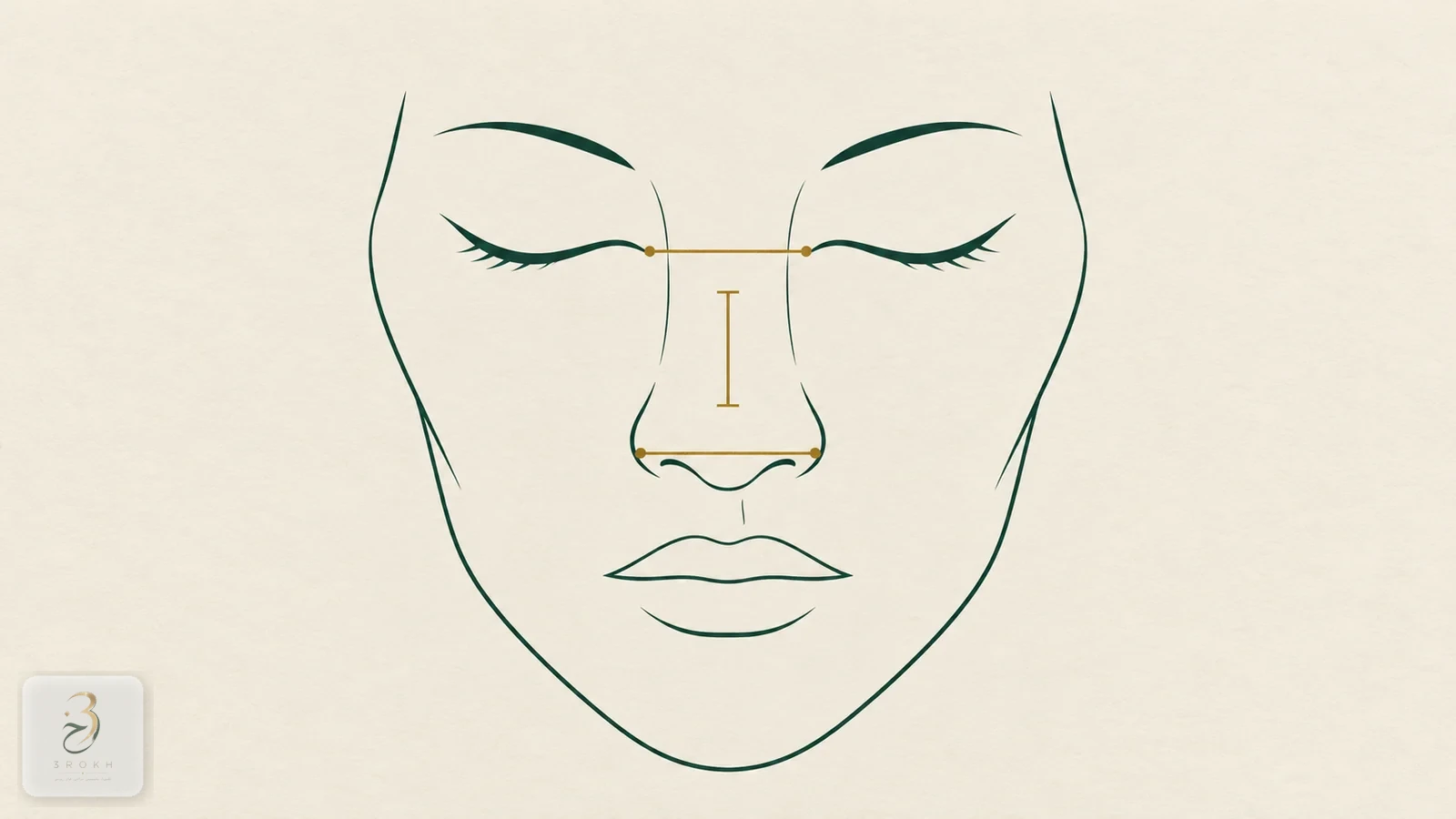
- Nose length against the width of its base and the distance between the inner corners of the eyes: in a study analysing about 5,500 Asian and Caucasian faces, the ratio of nose length to nose width, the ratio of the inner-canthal distance to nose length and the ratio of that distance to nose width played a role in facial attractiveness. By the same ratios, shortening a nose a great deal reduces the length-to-width ratio, which needs attention.
- Bridge and root of the nose: in another study that showed simulated images to 813 respondents, reducing a hump, and combining it with tip rotation, raised perceived attractiveness and health, whereas rotating the tip alone made no significant difference. That study was not about face shape, but it shows the bridge carries a lot of weight in how a viewer perceives the nose, so it should not be treated as just a function of a "round face".
- Tip rotation: more rotation means a nose that looks shorter and carries the risk of a "shortened nose"; the details are in the article on the nasolabial angle.
- Profile and the balance of forehead and chin: the nose is not judged alone.
These are what to ask about in the consultation. The "which model for a round face" answer cannot be read from a table.
A plump face is not the same as nasal skin
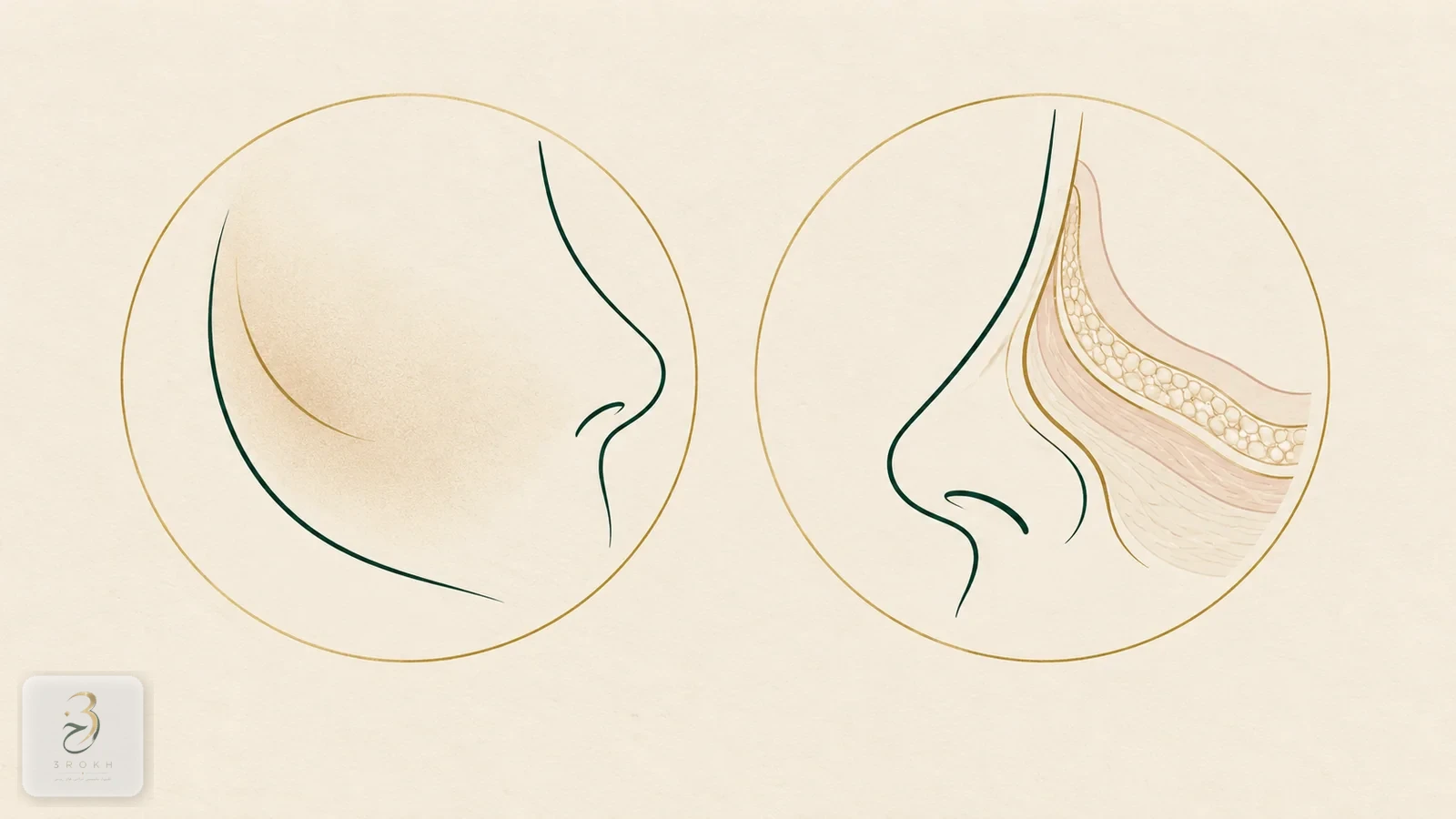
"Plump" usually refers to fullness of the cheeks and midface, but what matters in rhinoplasty is the thickness and behaviour of the skin and soft tissue of the nose itself. The two do not necessarily go together. In a small study of 29 patients using CT and ultrasound, body mass index was not associated with nasal skin thickness. The conclusion is that you should not guess thick nasal skin from a full face; the skin has to be examined, because it directly affects tip definition and the duration of swelling. For thick skin in detail, read the article on the fleshy nose and realistic results.
A few popular beliefs, set against the evidence
- "A round face needs a pointed tip." No trial has shown this. A pointed, pinched tip can look artificial on some noses and cannot be achieved at all on thick skin; skin thickness limits tip definition.
- "A smaller nose makes the face bigger and rounder." This comes down to proportion, not absolute size. A nose can be reduced to the degree the face and its structure accept, and reducing it further leads to a shortened nose and breathing problems.
- "I will just show the photo of that celebrity." Another face has other skin, cartilage and proportions; the photo is useful only to describe direction and feel, and your result will not be the same.
Weight and timing of the decision
Because weight changes the shape of the face, the proportion you see in the mirror today may differ at another weight. A single study cannot give a number for the effect of weight on a nasal result, but the sensible course is to tell the surgeon honestly about any plan to lose or gain weight before the consultation and to ask whether it is better to postpone the decision or the operation until your weight is stable. Stable weight also matters for judging photographs: a photo taken two years ago at a different weight does not show today's proportions accurately.

When my view and the surgeon's view differ
In a study of 300 patients, six surgeons scored nasal aesthetics from pre-operative photographs. The surgeons' scores agreed with one another, but the correlation between patient and surgeon scores was weak (about 0.07 to 0.20), and patients in the cosmetic group saw the nasal problem as more severe than the surgeons did. The practical meaning: something you find bothersome may not be the surgeon's biggest concern, or the reverse. To narrow the gap, talk through front, profile and three-quarter photos and ask the surgeon what they see in the same pictures; the limits of simulation are in the article on simulating the result of rhinoplasty.

What to ask in the consultation
- Which proportions in my nose are limiting: length, base, bridge or tip?
- How thick is my nasal skin and what does that mean for tip definition and the duration of swelling?
- How does my weight plan (if I have one) affect the timing of the decision?
- Is the result I have in mind achievable with my nose structure, or should it be milder?
- More questions are in the article on questions to ask a surgeon.

A consultation with Se Rokh's doctors is possible through booking, and the rhinoplasty page explains the scope of the work.

Sources
- Zheng S et al. Quantitative analysis of facial proportions and facial attractiveness among Asians and Caucasians. Math Biosci Eng. 2022
- Kandathil CK et al. Association of Dorsal Reduction and Tip Rotation With Social Perception. JAMA Facial Plast Surg. 2018
- Assiri H et al. Measurement of Nasal Skin Thickness and Body Mass Index in Preoperative Rhinoplasty Patients Utilizing Computed Tomography Scanning and Ultrasound Techniques. J Craniofac Surg. 2024
- Kim CH et al. Difference in Perception of Nasal Aesthetic Appearance Between Surgeons and Rhinoplasty Patients: A Single-Center Perspective. Aesthet Surg J. 2023
- Cone JD Jr, Hobar PC. The Short Nose. Clin Plast Surg. 2016
- Ishii LE et al. Clinical Practice Guideline: Improving Nasal Form and Function after Rhinoplasty. Otolaryngol Head Neck Surg. 2017
Frequently asked questions
Is a longer nose better for a round face?
It is a common saying, but no trial has proved it. What the surgeon measures is nose length against base width and the distance between the eyes; a study of 5,500 faces found these ratios play a role in attractiveness. Length must match your actual structure, not a "round face" template.
If my face is plump, is my nasal skin thick too?
Not necessarily. In a small study (29 patients), body mass index was not associated with nasal skin thickness on CT and ultrasound. The surgeon has to examine the nasal skin.
Does weight loss after surgery change the result?
Weight change alters face shape and may change how the nose relates to the face in your eyes. How much it affects the nose itself should be considered with your surgeon; it is best to be honest about your weight plans before the consultation.
Why do my view and the surgeon's view of the nose problem differ?
In a study of 300 patients, the correlation between patient and surgeon scores of nasal aesthetics was weak, and patients in the cosmetic group saw the problem as more severe than the surgeons did. A clear conversation with photos narrows this gap.
Related services
Comments
No comments yet. Be the first to write one.
Related articles
Medications and Supplements to Stop Before Surgery: What, and How Many Days Before
Aspirin, herbal supplements, birth control pills, isotretinoin — which ones really need to stop, how many days before surgery, and which must never be stopped on your own, sourced from Mayo Clinic, Cleveland Clinic and an independent scientific review.
Read moreDoes Insurance Cover Nose Surgery? Cosmetic vs. Medically Necessary, Explained
Insurers don't judge nose surgery by the result — they judge it by the documented medical reason behind it. When a case counts as therapeutic, when it's cosmetic, and how combined procedures get billed.
Read moreCan You See Rhinoplasty Results Before Surgery? Simulation and Its Limits
What computer simulation before rhinoplasty actually shows, and why it can't guarantee the final result — based on clinical studies, not an app roundup.
Read morePre-Rhinoplasty Tests: The List, the Timing, and How Long Results Stay Valid
Which tests you actually need, how many weeks before surgery to take them, how long each result stays valid — and what an abnormal value really changes.
Read moreWhat Is the Nasolabial Angle and Why Do Surgeons Care About the Number
The nasolabial angle is the angle between the columella and the upper lip and shows how much the tip is rotated. This article explains how it is measured, what numbers studies report and why there is no single number for everyone.
Read moreRhinoplasty Cost in Tehran: Dr. Hashemi's and Dr. Yousefian's Starting Prices
Rhinoplasty at Se Rokh starts between 58 and 68 million toman — but what matters more than the number is what sits inside it and what is billed separately. Each surgeon's starting figure, the exact boundary of the quote, and what to send for an accurate price.
Read more