

Rhinoplasty
Natural Male vs Female Nose: What Actually Differs

Quick answer
Male and female noses differ in tendency, not in rule: in studies, men's noses usually have a wider base and tip, the preferred angle between nose and lip is usually smaller for a male nose (from about 1 to more than 10 degrees smaller across studies), and male rhinoplasty should keep masculine features and not feminise or over-sculpt the nose. A natural nose, for both, means one proportionate to the face with no sign of surgery.
- Size and base
- Men's noses usually wider; population dependent
- Nose-lip angle
- Usually less rotated for men; 1 to more than 10 degrees gap across studies
- Main risk in a male nose
- Feminising or over-sculpting
Instead of "masculine/feminine", state with photos the features you want to keep or change.
Key points
- Differences between male and female noses are tendencies, not rules.
- In male rhinoplasty, masculine features should be preserved and the nose should not be feminised or over-sculpted.
- A natural nose for both sexes means a nose proportionate to the face with no sign of surgery.
How do natural male and female noses actually differ?
Male and female noses differ mostly in tendency, not in rule. In studies, men's noses usually have a wider base and tip and a thicker columella, and the angle preferred between nose and lip for a male nose is usually smaller (less rotated) than for a female nose; but the gap has been reported anywhere from about one degree to more than ten, and it depends on the population and the way it was measured. In surgery, a specialist review of male rhinoplasty advises that masculine features be preserved and that the nose not be feminised or over-sculpted. "Natural", for both sexes, means a nose proportionate to the face that shows no sign of surgery.
This article is educational, gives no diagnosis or individual plan and does not discuss price; for cost, see the article on the cost of male rhinoplasty.
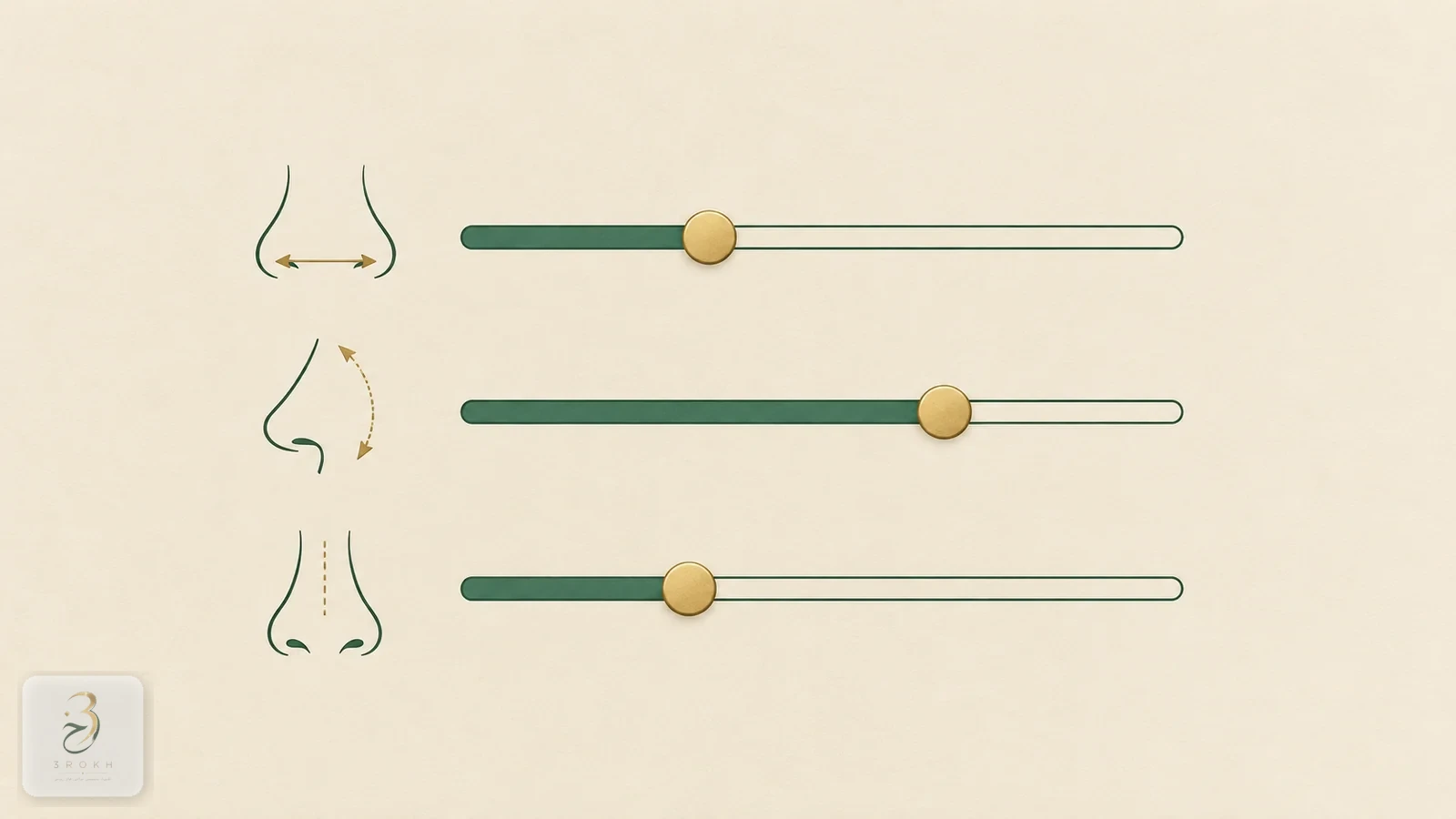
What "natural" means for each sex
In patients' conversations, "natural nose" usually conveys two things: the proportions match the face, and nobody realises at first glance that it was operated on. That definition is the same for men and women, but the starting point and the limits differ. For a man who says "natural", it usually means keeping the strength of the bridge and tip and avoiding a fine, polished look. For a woman who says "natural", it usually means softness of the tip and bridge without an artificial, over-rotated look. The same word can carry two different goals, and sometimes two people of the same sex mean different things. So the right start is to translate "natural" into specific features, the same thing we did for other everyday names in the article on doll versus Barbie nose.
Common differences in a table
| Feature | Common tendency in a male nose | Common tendency in a female nose | Note |
|---|---|---|---|
| Base and tip width | Wider | Narrower | Population dependent (Chinese and Tibetan studies) |
| Columella and alae | Larger | Finer | In the 900-person Chinese sample |
| Nose-lip angle (preferred) | Smaller | Larger | Gap from about 1 to more than 10 degrees |
| Tip rotation | Less | More | Goes with the nose-lip angle |
| Bridge | Firm, usually straight | Softer, sometimes slightly curved | Common teaching description, not a rule |
The "bridge" row is a common teaching description and not a verdict for your nose; structure differs from person to person, and many women have a strong nose and many men a fine one.

What do the measurements say?
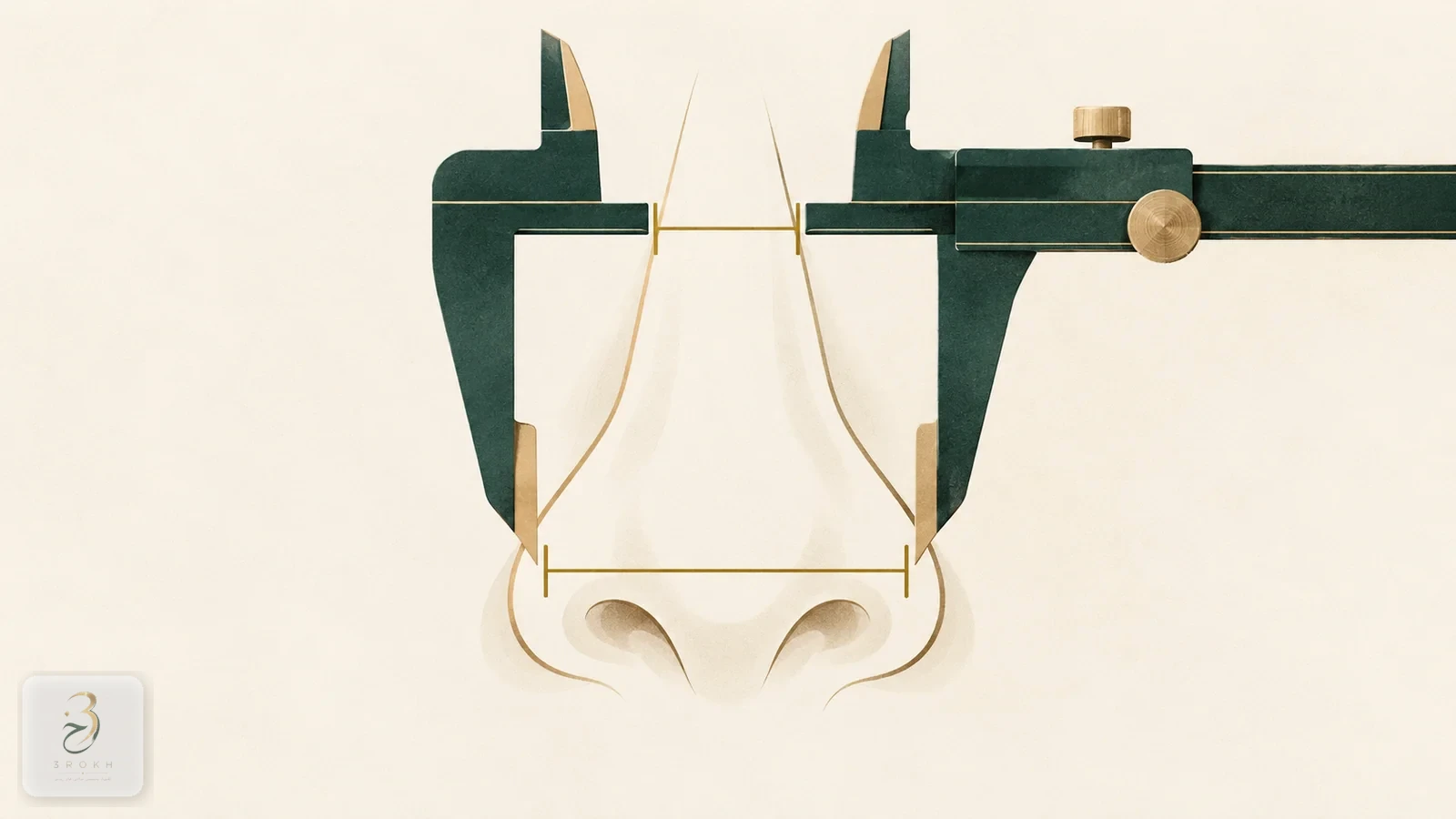
Two anthropometric studies show sex differences, but the pattern depends on the population. In a study of 900 young Han Chinese adults (501 women and 399 men), women had significantly smaller nasal base, alar length, alar thickness, columella height and width and tip width than men. In a study of 508 young Tibetan adults (233 men and 275 women), men had greater nasal width and depth and women greater nasal height; nasal type also differed significantly between the sexes (mesorrhine was most common in men at 65.7% and leptorrhine in women at 58.2%). These are averages, and a Chinese or Tibetan "standard" must not be applied directly to an Iranian patient; the Iranian preference data are in a later section. But they show the general principle: nasal sizes and proportions overlap between the sexes, and there is no sharp boundary.
The nose-lip angle for men and women
Because tip rotation is one of the main tools for making a nose look "masculine or feminine", many studies have measured the preferred angle separately for the two sexes. The results are very different: in a study with 16 raters, the preferred angle was about 96 degrees for men and about 98 for women; among members of the Rhinoplasty Society, about 94 to 97 for men and 97 to 100 for women; in a survey of 98 lay volunteers, about 97 for men and 105 for women; and in a survey of 197 people in Canada and the Middle East, about 97 and 109.5. By contrast, in the study of 1,027 Saudi raters about 90 degrees was preferred for both sexes. The details of these studies and why they disagree are in the article on the nasolabial angle. Three things matter for your choice: there is no fixed number, the gap between the sexes is small in some populations, and regional taste can narrow the "male/female" gap.

The language of analysis: nasofrontal angle, root and bridge
When a surgeon analyses a nose in profile, there are several set tools. The nasofrontal angle is the angle that the forehead and the bridge make at the root; the wider it is, the "lower" the root of the nose looks and the softer the junction between forehead and nose. In a study that varied this angle on a male profile and had patients, lay people and surgeons score it, an angle of about 130 degrees was ideal, 127 to 142 degrees acceptable, and angles under 115 degrees (resembling a hump) the least attractive; surgeons judged less harshly than patients and the public. These numbers are for a male Caucasian profile. The root is where the nose begins between the eyes, and the bridge is the line between root and tip; both play a large part in whether a nose feels "masculine" or "soft".
Iranian data: our own preferences
One of the important studies in this area is from Tehran. In it, manipulated images of one female and one male model were shown to 203 patients attending a facial plastic surgery clinic. The preferred nasofrontal angle was about 137.6 degrees for the male model and about 133.6 for the female model, wider than the usual 125 to 130; the preferred nasolabial angle (judging by the range of images used for each model) was about 98.9 degrees for the male model and 107.6 for the female model; and a straight bridge was the most desirable for both sexes. The authors concluded that Iranian patients prefer a thinner female nose and a wider nasofrontal angle, while the nasolabial angle, the height of the bridge and tip projection agreed with neoclassical canons. Preferences also changed with age: for example, young people aged 19 to 24 wanted a more acute nose-lip angle for a male nose.
| Measure (Tehran study) | Male model | Female model |
|---|---|---|
| Nasofrontal angle | About 137.6 degrees | About 133.6 degrees |
| Nose-lip angle | About 98.9 degrees | About 107.6 degrees |
| Bridge | Straight | Straight |
| Alar width relative to eye distance | About 0.5 mm narrower | About 1 mm narrower |
| Tip projection (Goode ratio) | About 0.56 | About 0.57 |
This table was made with one male and one female model and manipulated images, and is not a surgical result or patient satisfaction. We assigned the male and female values of the nose-lip angle from the range of images used for each model, because the abstract gives the two numbers with "respectively" and no labels.
Another study, from Ahvaz, examined 60 rhinoplasty candidates and showed that many of them fall outside classical criteria on several measures (including root position, nasofrontal angle, hump, base width and tip projection), while the nose-lip angle and columellar show were roughly half and half. The authors stressed that conventional criteria should not be the only measure of aesthetic suitability and that assessment should be combined with the patient's own goals and cultural taste. Both studies are small and limited, but they carry one clear message: the "textbook standard" is a starting point, not a verdict.
Base, alae and tip projection from the front and below
From the front, the width of the nasal base is usually judged against the distance between the inner corners of the eyes. In the Tehran study, the preferred alar width relative to this distance was about half a millimetre narrower for the male model and about one millimetre narrower for the female model, and participants aged 45 to 64 more often wanted a width equal to the eye distance. The ratio of tip projection to nose length was about 0.56 for the male model and 0.57 for the female (by the Goode method: projection of the tip from the alar crease divided by the length from nasion to tip), and the authors noted that another study had found the Goode ratio preferred in the general Iranian population. In other words, the difference between sexes in these measures is a fraction of a millimetre or a hundredth of a ratio, and what differs more is the person's age and taste rather than sex. The vocabulary is mapped in the article on nasal projection.
Age and prior surgery also change preference
In the Tehran study, participants aged 25 to 44 more often liked a more acute nasofrontal angle, and the youngest (19 to 24) a more acute nose-lip angle for a male nose. In the Sinno study too, male, younger and some ethnic-group volunteers preferred a more acute angle for a male nose, while those who had previously had rhinoplasty and those over 50 preferred a more obtuse one. So even "Iranian taste" is not one thing; a 20-year-old generation differs from a 50-year-old one, and a person's preference may change after surgery. This is one reason surgeons ask you to define the goal with photos, not adjectives.
Skin, oiliness and aftercare
In assessing skin, sex is not the criterion; the thickness and behaviour of each nose's skin must be judged by examination, because it directly affects tip definition and the duration of swelling (details in the article on the fleshy nose and realistic results). The male rhinoplasty review does, however, treat proper skin care, especially after surgery, as a key part of any rhinoplasty. Care instructions always come from your own surgeon and this article is not a substitute; for the general recovery picture see the week-by-week rhinoplasty recovery guide.
How to read these studies
Most of the numbers in this article come from opinion surveys on manipulated images: one or a few faces are altered on a computer and raters are asked which they prefer. This method shows taste, not the result of surgery and not long-term satisfaction. Raters differ too: surgeons, patients and the lay public each score differently, and in the nasofrontal-angle study surgeons were less strict than patients and the public. Samples are usually small (from 16 to a few hundred people) and the models are one or a few people. So the most useful way to use these numbers is to know that the range of taste is wide and that no magic number exists, not to build a number for yourself.
What is the same for both sexes
- Breathing: the American Academy of Otolaryngology-Head and Neck Surgery clinical practice guideline recommends that the surgeon or a designee assess rhinoplasty candidates for nasal airway obstruction and tell them what effect surgery may have on breathing. This is the same for men and women.
- The possibility of future surgery: the same guideline says the patient should be told that further surgery may be needed.
- Measure satisfaction at 12 months: the final shape of the nose settles over about a year, and the guideline recommends documenting satisfaction with appearance and function at least 12 months after surgery.
- Motivation and expectations: these should be asked about, their realism stated and the discussion documented.
If you are undecided after hearing all this, a cautious shape is usually safer, because softening is easier than reversing.
Three common misconceptions
- "A male nose means big and humped." Preserving masculine features does not mean keeping everything thought of as masculine; the strength of the bridge and root and a tip proportionate to the face can be preserved while a bothersome hump is removed. The surgeon must make these distinctions clear to you.
- "A female nose must be small and upturned." In the Tehran study even the female preference for a thinner nose came with a straight bridge, not a very high tip; and excessive rotation leads to a shortened nose.
- "One template for everyone." Studies show preferences change with population, age, sex and even prior surgery. The template in a book or on a celebrity is not a verdict.
Before the consultation: a simple exercise with photos
- Take photos from the front, a full profile and a three-quarter view with the head level and even lighting.
- On the profile photo, mark which features you like and want to keep (for example a high root or a firm bridge) and which you do not.
- Find one photo of a nose you want to resemble and one you do not, and write two sentences about why.
- Write down what "natural" means to you: "nobody should know I had surgery", "it should suit my face", or "like so-and-so"?
- If you are a man, write down which features you consider masculine and do not want changed.
These notes are more exact in the consultation than any name, and they narrow the gap between your view and the surgeon's that was seen in the studies.
The main risk in a male nose: feminising and over-sculpting
The review "Male Rhinoplasty: Update" says surgery on a man's nose requires precise planning; masculine features should be preserved and the nose should not be feminised or over-sculpted. That means strong tip rotation, heavy narrowing of the bridge and shrinking of the base can look "out of place" on a man's face even if each looks beautiful alone. The same review stresses clearer communication with male patients, screening for psychosocial disorders and skin care after surgery. Another review of male rhinoplasty says the surgical principles are similar in the two sexes but there are special anatomical considerations, and that body dysmorphic disorder is more frequent among male candidates and satisfaction harder to achieve, so the consultation needs to be careful and deliberate.
These statements do not aim to label men. The American Academy of Otolaryngology-Head and Neck Surgery guideline recommends assessing all rhinoplasty candidates for body dysmorphic disorder, because it lists it among the comorbid conditions that may modify or contraindicate surgery. If a surgeon asks you these questions, do not be put off; it is a sign of care.

And what is the risk for a female nose?
For women the risk is usually on the other side: over-rotation and over-shortening that lead to a "shortened nose", and sculpting so much that the face looks uniform and "templated". A specialist review of the "short nose" lists three shared features: a shortened nasal length, over-rotation of the tip and increased nostril show. So "more feminine" is not always better. In a study of 300 patients (64% women), the correlation between patient and surgeon scores of nasal aesthetics was weak, and patients in the cosmetic group saw the problem as more severe than the surgeons did; that is, a clear conversation with photos is needed for both sexes. The details of rotation and durability are in the article on the semi-fantasy rounded-tip nose.
Regional taste: why the Western pattern is not necessarily yours
A large part of the teaching literature is built on European and American samples, and the description of the "white male nose" comes from it; the 2023 review on gender considerations in rhinoplasty also compares the features of the white masculine nose with the feminine. But in the Middle Eastern study the preference was about 90 degrees for both sexes, and the author concluded that what counts as under-rotation in another culture may be the ideal in this region. So the male/female patterns in books may not match your taste or structure exactly. Before accepting a "standard template", ask the surgeon what population it was built on and what change they consider necessary for your nose.

When sex is not the criterion
Some people want their nose according to themselves, not according to "male/female"; for example a woman who likes a strong, straight nose or a man who wants a softer one. That is perfectly fine, provided you state the features specifically and the surgeon explains the limits of your structure. If your goal is a change of appearance related to gender identity, this article is no substitute for specialist consultation; specialist sources compare the features of the male nose with the female to define the changes needed for feminising rhinoplasty, and that route needs its own assessment.
A few ready sentences for the consultation
- "I want my bridge to stay strong but the hump reduced."
- "Please reduce the width of my tip a little, without my nose looking fine and small."
- "I do not want the tip to go too high; only a bit softer and better proportioned."
- "I want nobody to know I had surgery; what should we emphasise?"
- "What changes should I expect after 12 months?"
Sentences like these, instead of general adjectives, steer the surgeon toward specific decisions.
How to say it in the consultation
- Instead of "masculine" or "feminine", say which feature you want to keep (for example the strength of the bridge) and which to change (for example the width of the tip).
- Bring front, profile and three-quarter photos, ideally of a person whose structure is close to yours.
- Ask what range of rotation and narrowness the surgeon considers suitable for your nose.
- If you are a man, ask how masculine features will be preserved and what the post-operative skin care is.
- State your expectations and fears frankly; the American Academy of Otolaryngology-Head and Neck Surgery guideline says the surgeon should ask about motivation and expectations, say whether they are realistic and document it.
- Read about the limits of simulation in the article on simulating the result of rhinoplasty and find more questions in the article on questions to ask a surgeon.

When to consult in person
- When you can describe "natural" with only one adjective and have no specific photo.
- When you worry about looking more feminine or masculine after surgery.
- When you have thick skin, a short nose, a deviated septum or previous surgery.
A consultation with Se Rokh's doctors is possible through booking, and the rhinoplasty page explains the scope of the work.
Sources
- Rohrich RJ, Mohan R. Male Rhinoplasty: Update. Plast Reconstr Surg. 2020
- Wayne I. Contemporary Male Rhinoplasty Surgery. Facial Plast Surg Clin North Am. 2024
- Rodriguez AM et al. Gender Considerations in Rhinoplasty. Plast Reconstr Surg. 2023
- Tavakoli K et al. Ideal Nasal Preferences: A Quantitative Investigation with 3D Imaging in the Iranian Population. Arch Plast Surg. 2023
- Aharipour A et al. Preoperative anthropometric assessment of nasal aesthetic parameters in Iranian rhinoplasty candidates: deviation from conventional normative standards. Maxillofac Plast Reconstr Surg. 2026
- Naini FB et al. Nasofrontal Angle and Nasal Dorsal Aesthetics: A Quantitative Investigation of Idealized and Normative Values. Facial Plast Surg. 2016
- Li KZ et al. Anthropometric nasal analysis of Han Chinese young adults. J Craniomaxillofac Surg. 2014
- Zhong H et al. Nasal Morphology of Tibetan Populations: Sexual Dimorphism and Regional Variation. J Craniofac Surg. 2026
- Armijo BS et al. Defining the ideal nasolabial angle. Plast Reconstr Surg. 2012
- Brown M, Guyuron B. Redefining the ideal nasolabial angle: Part 2. Expert analysis. Plast Reconstr Surg. 2013
- Sinno HH et al. The ideal nasolabial angle in rhinoplasty: a preference analysis of the general population. Plast Reconstr Surg. 2014
- Alharethy S. Preferred nasolabial angle in Middle Eastern population. Eur Arch Otorhinolaryngol. 2017
- Alshawaf SM et al. Preferred Nasolabial Angle in Rhinoplasty: A Cross-Sectional Analysis. Aesthet Surg J. 2024
- Cone JD Jr, Hobar PC. The Short Nose. Clin Plast Surg. 2016
- Kim CH et al. Difference in Perception of Nasal Aesthetic Appearance Between Surgeons and Rhinoplasty Patients. Aesthet Surg J. 2023
- Ishii LE et al. Clinical Practice Guideline: Improving Nasal Form and Function after Rhinoplasty. Otolaryngol Head Neck Surg. 2017
Frequently asked questions
What features does a male nose have?
There are no fixed features that hold for everyone, but in studies men's noses usually have a wider base and tip and a smaller preferred angle between nose and lip. These are population averages, not a rule for your nose.
If I am a man and I raise the tip, does the nose become feminine?
Strong tip rotation usually comes with a shorter, finer nose that looks more feminine, and specialist reviews of male rhinoplasty advise keeping masculine features and not feminising or over-sculpting the nose. The right amount of rotation is set by the surgeon from your face.
Does rhinoplasty carry different risks or considerations for men?
The surgical principles are similar, but specialist sources stress a more careful pre-operative conversation, review of expectations and screening for body dysmorphic disorder, and skin care after surgery.
Is the preferred nose-lip angle the same everywhere?
No. In a study of 1,027 Saudi raters about 90 degrees was preferred for both sexes, whereas Western studies have reported larger sex differences.
Related services
Comments
No comments yet. Be the first to write one.
Related articles
Male Rhinoplasty Cost: Why It Is Often Said to Exceed Female Rhinoplasty
Male rhinoplasty has no fixed figure; thicker skin, a larger nose and the need to keep a masculine look make the work more exacting. This article explains which factors may affect cost and what to ask.
Read moreWhat Is Nasal Projection? A Map of Nasal Terms With Reference Numbers
Projection, dorsum, radix, columella and the nasolabial angle — the terms a surgeon uses in consultation, with reference ranges and an answer to why a nose can look more projected after surgery.
Read moreInstalment and Staged Payment for Nose Surgery: What Is Reasonable and What Is a Warning Sign?
We look separately at three models: staged payment, credit and cheques or notes, with a list of the paperwork you need, four refund situations and ten warning signs before the first payment.
Read moreWhy Does Revision Rhinoplasty Cost More Than the First Surgery?
Revision rhinoplasty typically costs more than a primary nose job. This guide explains the real reasons — from scar tissue to cartilage grafting — and how to manage the cost wisely.
Read moreAnemia and Rhinoplasty: What Hemoglobin Level Cancels Surgery?
There is no single fixed, universal hemoglobin number that automatically cancels a rhinoplasty; the decision rests on how severe the anemia is, its cause, and symptoms. This article covers the real reference bands and the reasoning behind each decision, with sources.
Read moreFixing a Crooked Nose Without Surgery: What Filler Can (and Can't) Do
A crooked-looking nose and a true deviated septum are two different problems. What filler can realistically do, where nasal strips fit in, and when septoplasty is the only real answer.
Read more